That yummy looking chicken on your dinner table? Did you ever wonder were it came from? Well we did and now we know.
First it's a little baby fuzz ball that comes in the mail. You can get mail order chicks from Murray McMurray and many other hatcheries The post office is always very eager to get them to you and will probably call repeatedly until you pick them up.
 When you get them home you need to put them in a draft free box. They should have a light for warmth. Food can go on the floor for the first couple days. Water can go in jar lids. After about two days you'll need to start using feeders and waterers.
 And in a few weeks they get big enough to go outside. Once they are ready to go outside there are many different styles of chicken coops to keep them in.
 These are Buff Orpington pullets
and these are white broilers the same age.
 They are the same age but the broilers are much bigger then the layers because they are bred to grow big and fast. We would recommend that you raise a heritage breed like Kosher Kings. You can get Kosher Kings from Clearview Hatchery in PA 717-365-3234. The standard white broilers have all sorts of problems like they are prone to heart-attacks and leg issues.
If you don't like reading about slaughtering then don't read any farther.
After we had walked around and seen the set up for the live chickens we got ready to kill, pluck, gut and dress. You shouldn't feed your chickens for 24 hours before hand. When you go to bring your bird to where you're going to kill it, pick it up by its feet so the blood goes to its head and it doesn't struggle.
 Then you hang them up by the feet against a flat surface. Another way that works really well is an up-side-down old traffic cone with the end cut off.
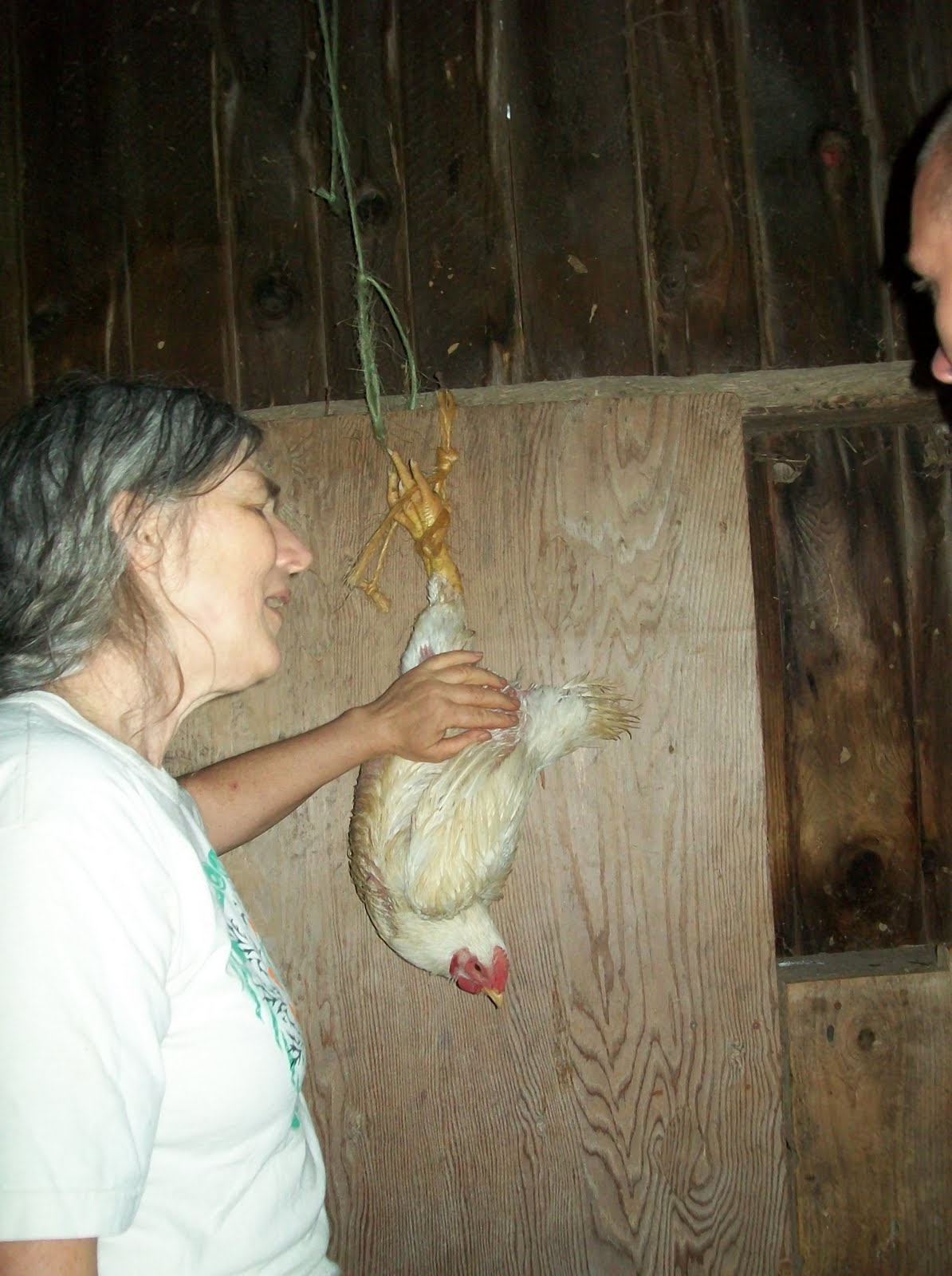 First you open the beak and then you stick your knife up through the roof of the mouth and twist it. Then you slit the bird's throat and let it bleed out.
You need to hold the bird still after you have killed it until its death throws have stopped.
If you're using cones you don't need to worry about this.
Once the bird is dead it's time to pluck it.
We scald them first so the feathers come out easier (it also makes the bird stink wretchedly, but it really helps with the feathers so it's worth it). The water should be about 180F. It helps to put some dish soap in to break the natural waterproofing on the bird's feathers. They're done when you can pull tail and wing feathers out. If you scald them to long they start to cook and then the skin rips when you are plucking.


Now it is time to clean and dress them.
The first step is to take the head off.
 You cut a ring around base of the head cutting through the muscles and tendons. Then you grab the head and twist it off. DO NOT try to cut the bone. It kills your knife.
Once the head is gone next comes the feet. You put the bird on its back. Then you take one of the legs and bend it backward so you can see the joint. You'll see two sets of two round lumps and you cut right in between them.

 The joint will separate, so you don't need to cut the bone.
Next flip the bird back over onto its front. Then slit the skin on the neck starting from in between the wings.
 Use your fingers to separate the skin and gland from the neck and then the glands from the skin.
 Then you make another ring like the one you made to remove the head at the bottom of the neck. Once again NO CUTTING BONE. And break and twist the neck off.
While the bird is on its front it's time to remove the oil gland.
 They are on top of the tail.
Now it is time open the cavity. Flip the bird onto its back. You make a small cut across horizontally and then use your fingers to finish it. Be careful not to cut the intestines.
 Then you cut down and around the anus in a horseshoe shape.
 Next you reach in with two fingers and loosen every thing from the top of the cavity.
 Once everything's free from the top you reach forward to the front of the cavity. You'll feel a small hard lump. It's the heart. Grab around it and pull.
Everything should come out.

After all the guts are out you can pick out and save the heart, liver and gizzard. When taking the liver remove the gall bladder. Do not break it!! It will taint the meat and make it bitter.
The only thing that won't come out are the lungs. You need to reach back in and get them. The lungs are attached in the front of the cavity on either side of the backbone. Use your fingers in a hooking motion and they should come out.
That should be everything, just check and make sure. Then hose the bird out well.
Keep the bird in you frig at least 24 hours before you cook it.
Yummy dinner!


