Saturday, April 14, 2012

Gardin' Guards

 We sanded...
and painted whirligig parts to vibrate the earth to deter moles and mice

...and learned about using ground eggshells to stymy slugs.
marigolds, tansy, and garlic to inhibit insect invaders,
urine, soap, human hair, and blood to discourage deer and ward off wabbits!
AND the watchful eye of a friendly scarecrow/garden goddess!

Friday, March 9, 2012

Bee Candy and Bee Tea Recipes

Many Thanks to Alton Earnhart for sharing the following directions:
I have been warned about offering syrup when it is still too cold, but am just sure they need whatever they can take in when it's warm enough. The bee candy is safer when still cold.

For 1 batch bee candy and one batch 2 qts., Bee tea.

I would offer the following tool list. Four or five quart pan with heavy bottom if possible, measuring cup, a candy thermometer, wisk, two cookie sheets, and parchment paper.

Have on hand 7lbs. Of white sugar, 1 bag chamomile tea, and if possible cider vinegar of good quality or skip this ingredient, dash salt.

1 pint white sugar = 1lb. In the USA, And 1pint H2O=1lb. The world around.

Make yourself a couple of cups of chamomile tea using the one tea bag, and put 4oz. Of the tea in your measuring cup. If you have an ounce of good quality cider vinegar like Braggs, add that to the measuring cup. To the tea and vinegar add 11 ozs. H2O (Should now be 1 pint or 16 ozs. of liquid) and pour into the pan. Add the dash of salt. Situate the candy thermometer so you can read it very accurately on the side of the saucepan. On a med. High heat bring the water to simmer and begin adding the sugar while stirring with the wisk. Allow to boil, with the goal being to dissolve the 5 pints of sugar into the liquid in the pan and bring this to 238 degrees F. No more or the candy is too hard, no less or the candy is too soft, but know this because you will want to learn for the next time to do better, depending on the accuracy of the thermometer. At reaching 238 degrees remove from heat while still constantly stirring, and allow to cool to 190 degrees, and then pour onto the parchment paper on the cookie sheets. I have the cookie sheets on cooling racks with parchment paper ready before starting.

Whether too hard, too soft or just right, determines mostly how you can handle easily or not so easily the candy placement directly over the frames in the top of the hive. The bees of course prefer you get it just right, but they can work the real world as well as you and I. I have made myself 1 1/2" thick hive spacers to place on top of the hives, (this allows the space for the candy, and if you can get ahold of tongue depressors or small sticks to put under the candy) above which I placed the inner cover, and I also placed an empty shallow super to feed bee tea when it gets a little warmer. Then I have a second inner cover over the shallow super, and 1 section of folded newspaper on top of that, and then the outer cover. I think you could get away without the second inner cover at the top, but even a piece of cardboard would help keep the cold metal top and warm inner air from dripping down.

So now you have a sticky saucepan and wisk, and 2lbs. Of sugar and maybe even a little tea left. Make the bee tea to have for mid to late ? May, maybe April this year? You can clean up the saucepan and wisk of the sticky candy left on them. You will make a 1:1 sugar to tea-water mix. That means the liquid portion will be 2 pints or 32ozs. If you haven't already drank the remaining 12ozs. Of tea from before, begin with that, if you drank it make some more as before, 1 bag for two cups. Add 20 ozs. Of water to the 12 ozs. Of chamomile tea. In the saucepan bring the liquid to a boil. If you have a tablespoon or two of thyme you can add that too. Reduce heat to a simmer. Add the 2lbs. Of sugar slowly enough to dissolve well.

All this requires about an hour and a half from the time you have assembled everything until done with making the bee tea. By the time you finish the bee tea the candy should have cooled enough to remove the parchment paper and candy from the cookie sheets and cooling racks so you can clean everything up and be done.
On March 8, Alton sent: "Here is the pix of the hive from this morning with the candy in the hive spacer I made"
lucky bees! Thank you Alton!
.

Wednesday, February 22, 2012

Serious Dough at Geer Village

Last summer, Nancy Berry attended our "Rolling in the Dough," Bread Baking workshop with her daughter-in-law, Erin. Nancy found kneading bread dough to be so soothing, she wanted to make that experience possible for the residents at Geer Retirement Village in Canaan, CT. So, she spoke with Geer's recreational director, Scott Zbell and with Motherhouse's Debra Tyler and on February 22, 2012, our workshop traveled to the "Country Kitchen" of Geer Village...

In loving memory of Nancy's mother,
Mrs. Nancy Griggs

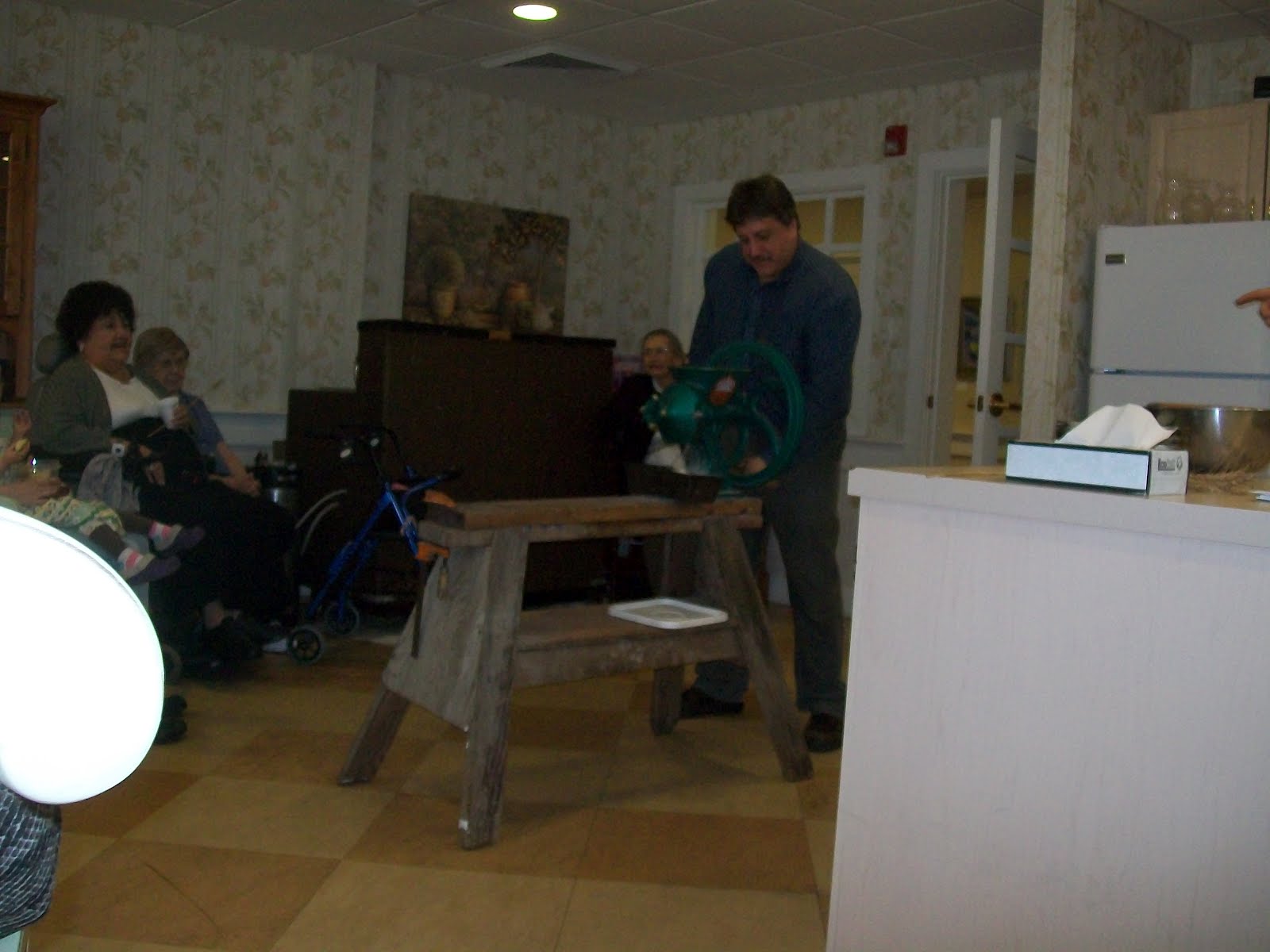
First we looked at seed-heads of dried wheat plants and the small kernels of grain called wheat berries. Then, we ground some into flour. Our mill has an extra long handle so two people can work together to turn the crank. Here are Elizabeth and Debra grinding flour together.
Scott took a turn too!
After mixing the ingredients, we all kneaded the dough. Tal and Abi Pease had also been at last summer's workshop and came along for a refresher and to help.
After the dough was well mixed and kneaded to a smooth consistency, we set it to rise in a bowl coated with sesame oil. Abi carried the bottle of oil around so all the residents could smell its delicious nutty aroma.
When the dough had risen to "double-in-bulk," we "punched it down," let it rise a second time, then formed it into loaves. Tal brought pecans, cinnamon, sugar, raisins, and chocolate chips to roll into our loaves if we wanted.
Then we set our loaves aside to rise a third time.
We also made individual bread "sculptures." While waiting for the bread to rise, we talked about the nutritional benefits of home-made whole-grain bread and how to make butter.
A peek in the oven at our sculptures.
As the bread baked, the smell wafted throughout the building and we found ourselves greeting more and more people who had followed their noses to the door.
Finally!!! The moment we'd been waiting for!!!
Scott served tea and coffee, we sliced up a couple loaves to sample, and all the participants went home with their own sculpted dinner roll.
Thank you, Nancy!

Saturday, February 18, 2012

Family Cow Forum

Family cow enthusiasts gathered on Saturday morning at the UCC-Cornwall CT Parish House to share their triumphs, passions, experiences, and info. Hot drinks were provided by Naren Sonpal of Coffee, Tea, Etc., Goshen. His fair-trade, organically grown coffee, tea, cocoa, and spices along with Local Farm milk made an unbeatable delicious flavor combination.

Alton Earnhart of Lightning Tree Farm in Millbrook, NY, talked about forage analysis. Panelists; Catherine Evans, David and Donna Hersh, Emy Osborne, Joe Benette, and Wyatt Whiteman discussed their discoveries, trials, tribulations, and triumphs as backyard cow keepers. Gund Sonpal of Sonpal's Power Fence (860-491-2290), described the products she sells from her home in Goshen, CT and Kathy Johnson of the Natural Resources Conservation Service gave a non-electric power point presentation about rotational grazing. After a potluck lunch, some participants showed various styles milking machines; from an old fashioned Surge milker that hangs off a strap over the cow's back to hand held plastic contraptions looking not much different from a spray bottle.
Wyatt Whiteman shows us his non-electric E-Z Flow Milker...
A lifesaver for a person with big hands and a tiny cow!

The younger participants enjoyed playing in a watering tub filled with shelled corn and jumping rope.

Desiree Ball demonstrated Tips and Tools for home cheese-making.

... and there we have it, Folks: CURDtains on a lovely day!

Saturday, February 4, 2012

Big Little Kids Dance

Led by Tom Hanford
75 children and adults

Music by an ad hoc bandRachel called a few

Curtain Call
Post-Dance Pot-Luck

Saturday, January 14, 2012

Farm Camp Reunion


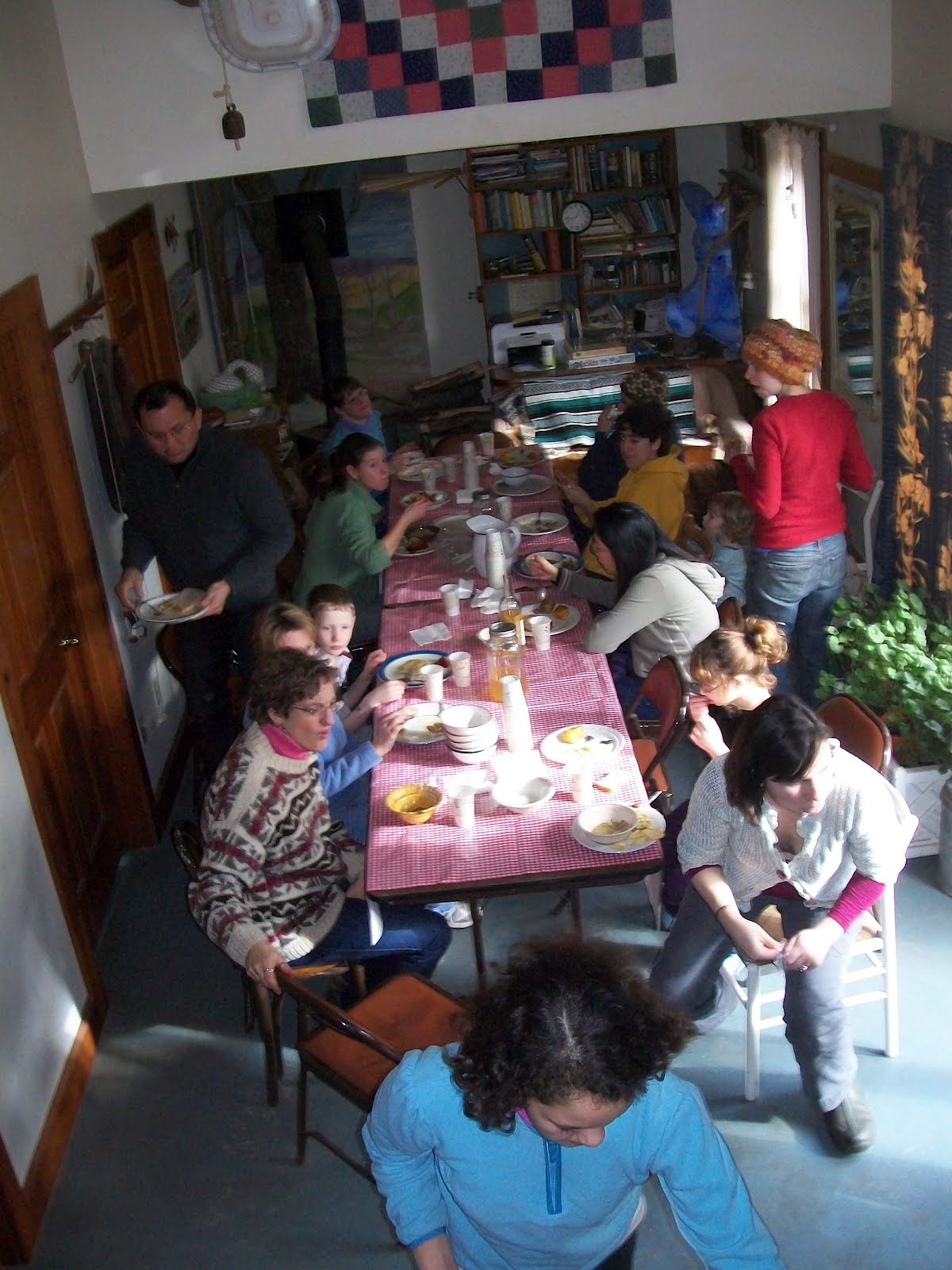
Farmers, staff, campers and their families feasted together over a great potluck and many fine memories. To see a You-Tube slide show of Juliet's photos, click HERE