Saturday, February 8, 2014

A SUDSational Workshop

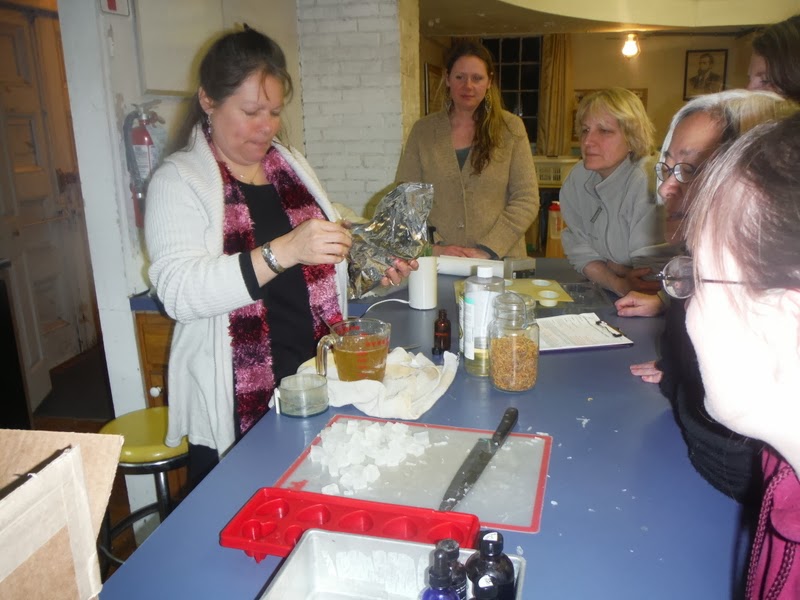
We met at the Taghhannuck Grange hall for an evening of fun and lather...
Sharon Laughlin of Made for You soaps started off the evening by demonstrating how to use the cold water lye process to make Gardeners' Soap with a natural degreaser... coffee!  She makes a batch of coffee and freezes it in ice cube trays. Wearing rubber gloves, a surgical face mask, and full plexiglass face shield, she sprinkles the correctly measured lye over the ice in a heavy duty plastic pitcher. The lye melts the ice and the resulting mix is around 100 degrees. Sharon lets it cool as she warms her oils.

When oils and the coffe-lye mix are both between 80 and 98 degrees she mixes the coffee-lye into the oils and blends with two(!!) hand held blenders...
.

...until the mixture thickens and begins to "trace." Then, she stirs in ground coffee beans and pours the whole mixture into molds.

She has beautiful hand-made molds of Corian scraps leftover from her husband's kitchen business. The ends pull out so she can easily push the soap out after it hardens. To prepare the molds, she slathers them with mineral oil, lines them with parchment paper, and oils the paper.
Once the mold is full, she covers the soap and wraps it up in a blanket to keep warm as the lye and oils interact or saponify.
In about two days the soap will be ready to slice. Again, Sharon shows her clever use of Corian scraps with her own home designed soap slicer. Once sliced, she'll label the soap with the date and recipe and lay it on racks to cure for 6 weeks. She uses ph paper to check for when it is fully cured and safe to use... around ph7.

Then I talked about making milk soap and using lard instead of vegetable oil. You can see last year's post for information about that.

Next, Alicia North of North Star Botanicals showed us how to use melt-and-pour glycerin soap base to make "Earth and Ocean Lemon Grass Soap."
 First she used a knife with a big blade to cut the block into cubes and put them in Pyrex measuring cups.
Then we heated the soap cubes in pans of boiling water until it melted.
Alicia added castor, jojoba and avocado oils to the hot liquid base. After the mix cooled slightly, she stirred in ground calendula blossoms for a golden color that won't spoil or turn brown and skin healing properties, kelp powder for additional minerals, and essential oil of lemon grass for the lovely scent as well as its antimicrobial/antibacterial action. Alicia warned us to be cautious with lemongrass on delicate tissue!  We then poured the mix into molds...
... spritzed them with rubbing alcohol in order to break any bubbles on the surface, and took them outdoors to speed-cool.
To get them out of the molds, Alicia puts them face down on a cutting board and (VERY) firmly presses from outer edges toward center of each mold until the soap releases.

Finally, for a soothing wash for poison ivy sufferers, we stirred a decoction of jewelweed into another batch of melted base. I harvested the plant late last summer and simmered it in water for about 20 minutes, strained out the plant matter, and froze the brew.  We added about 1/4 cup to a pound of soap base.


Tuesday, August 20, 2013

Farm Camp EUREKA!!!!

The 2013 session of Camp Eureka was our best yet! We visited 5 different Cornwall farms and explored the source of bread, butter and yogurt; honey and granola; fruit and honey peach jam; wool, fiber, and woven belts; healing herbs, soothing salves and scentsational sachets. After carving wooden spoons under the direction of Lost Arts officiando Joe Brien, our week culminated with an overnight in the Local Farm barn. Peruse our scrapbook to catch some of the wonder of a wonderful week...

Thursday, July 11, 2013

Homeschool Forum

One score and five people gathered at Local Farm today to consider various aspects of homeschooling. Starting off with a panel discussion moderated by 18 year-old homeschooled Margaret Hopkins, panelists Vicki Harkness, Bianca Fiore LaPorta, Alicia North, Deirdre Fischer and Debra Tyler spoke of: the "type" of homeschooling they practiced; their greatest challenges as homeschooling parents; and how they answered the commonly asked question, 'What about socialization?' This was followed by a 12 minute brainstorming session of places to go and things to do as homeschooling families. Former principal of Cornwall Consolidated School, Kathleen Fitzgibbons, next spoke of how she reached out to homeschooling families during her principalship. She enthusiastically encouraged us all to be true to ourselves. She also shared a personal antidote about meeting children's author and Newbery Award winner, Elizabeth Yates.
After a fabulous pot-luck lunch, Debra showed examples of home-made books as homeschooling helps and we collaboratively elaborated & illustrated a simple book based on our brainstormed list:

Places to Go, Things to Do...
Go to Asia, Africa, South America; TRAVEL; Thompson Finch Farm; Sturbridge Village; Peabody Museum; Local Farm; Warner Theater; Ellsworth Farm; Edwards, CA; home; water; Sloane-Stanley & Mineral and Mining Museum; Norman Rockwell Museum; volunteer; Audubon; 4-H; The Met; New York City; USS Intrepid; grandparents; Waldorf May Day; city camp; Hancock Shaker Village; Danbury Rail; Kent Falls; library, Post Office; bank; playground; beach; berry picking; farm market; grocery store; firehouse; local schools; Popple Swamp Road salamander migration; White Memorial; Mass MOCA; Kent Coffee and Chocolate; hiking; skiing; snowboarding; kayaking; canoe; tractor pulls; herb walks; foraging; Catamount; Motherhouse events; grow own food; anywhere/anything to do with food; backyards; apprenticeships; gardens; Grange events; Geer; build a jet fighter; concerts; round sings; make music; contra dances; Tanglewood; Jacob's Pillow; Oswego, NY; Cooperstown, NY; road trips; debate teams; Park & Rec; National/State Parks; Community Centers; Little Guild; animal shelters; tree-houses; blanket forts; sewing; make a corset; shoe-making; masonry; build a stone wall; swimming; homeschool fairs;
robotics club; Legos; Little House on the Prairie picnics; Medieval Fairs; crocheting; repair an F-22; painting; reading; pottery; music lessons; archeology; service; yoga; tie-dye; languages; blacksmithing; fencing; book groups; dance parties; any river...

Friday, June 21, 2013

Singing in the Solstice

 On June 21, a few heart-y souls gathered between rain showers at Local Farm
 to sing in the solstice, to mourn the loss of a mulish friend, and to sing up the near full-moon...

Saturday, June 15, 2013

Milkin it for all it's Worth

Thanks to Emily Boutein for these Bovine photos of our June 15th Family Cow workshop!
We tried our hand at milking a Local Farm jersey cow named Pumpkin...
 First we brushed her to get rid of loose hair and dirt so it wouldn't fall in the milk and to help us all relax. A relaxed and happy cow will give MOOre milk!

 We learned where to rest our head so we can keep a cow from kicking the bucket.
In anticipation of getting her own cow, Lynn is VERY MOOtivated!
 Milk comes from the cow at about 100 degrees... the perfect  temperature for making yogurt. Simply mix a little starter from a previous batch into the warm milk, pour into jars and keep warm for 6-10 hours. We set our jars in a cooler filled with warm water.
  The cream rises to the top of whole raw milk that has set over night. One can lower a ladle into the cream and let it slip over the lip of the ladle filling its bowl. Pour the cream into a jar and shake it up.
Vigorously shaking the cream disturbs the surface tension of individual fat globules and join together to make...
 BUTTER!
We learned that only raw milk will make simple "magic" cheese. Heat the milk until tiny bubbles form around the edges of the pan and stir in vinegar until the mix "magically" separates into curds and whey. Strain away the whey...
 and CHEESE!, There you have it!
Top off a MOOrvalous day with  creme de la creme: hand-cranked ice-cream!


Saturday, June 8, 2013

Weed-Made First-Aid

It was a sparkling day for a stroll around the Local Farm barnyard with local herbalist, Alicia North of Northstar Botanicals.  As we crossed the lawn, heading toward a patch of nettles, Alicia pointed out plantain; one of the primary healing "weeds" that we'd harvest for our salve. Later, in the pasture, we'd find two varieties of plantain;

Common Broad-leafed Plantain or "White Man's Foot" has followed European colonization throughout the world. It is slightly astringent and stimulates healing of skin wounds, The juice is said to soothe bee-stings, bug bites and nettle burn. Debra remembers her young son's playmates chewing up the leaves and applying the mash to cool and soothe bee-stings.
The primitive Ribwort or Lancelate Plantain has long, narrow, ribbed leaves harkening to prehistoric times and has properties very similar to Broad Leafed Plantain. We collected leaves from both.
At the nettle patch, Alicia spoke of Stinging Nettles as a blood-building herb, a fiber plant, and a delicious health-filled spring green once it has been cooked and lost its sting. The stinging nettle hairs contain formic acid and flogging oneself with the plant increases blood circulation. This practice is said to be useful in decreasing arthritic inflammation.
Asked about plants historically used to help with digestive complaints, Alicia suggested Catnip which is also mildly stimulating. She suggested bruising the fresh leaves in cold water as a good summer drink.

Next to the Catnip was a thriving plant of Greater Celandine with little yellow flowers. Its bright orange juice is said to be a cure for warts and in Russia, the plant has been used in treating cancer.
We next harvested Chickweed to supplement our salad as well as an addition to the salve for its cooling, inflammation reducing qualities.

To make the salve we steeped chopped or broken up herbs in warm olive oil for an hour. We put our pan of oil and herbs into a second pan of hot water - being careful not to cook the herbs.


While they steeped Alicia showed us her personal first aid kit with...
 Essential oils of thyme and lavender for repelling insects and calming excitement...
 Homeopathic remedies for allergic reactions, motion sickness, headaches, etc...
Sea bands for stimulating an acupuncture point helpful in reducing nausea...

Charcoal capsules to take in case of food poisoning. And much more!


After a delicious pot-luck lunch including salad supplemented with red clover blossom, chickweed, and sorrel; sauteed nettles; and steamed lambs quarters, we strained the herbs out of the oil, added beeswax, and poured the warm mixture into small containers to cool and take home.