Saturday, July 11, 2015

Jammin' with Little Green Apples

 Today we met at Taghhannuck Grange #100 in Sharon, CT for a Jam Session! For making all-natural pectin, Brent Prindle let us use his basket pole to pick green apples.
 We took off their stems, cut them into quarters, and...
 dumped them into a saucepan with just enough water to cover. While they cooked until soft on the stove...
 Tal Hadani-Pease showed us how to make mixed-berry jam with honey and Pomona Universal Pectin.
 We used Brent's magnetic tool rod to dunk the jar lids in hot water for 10 seconds....
... and then, tighten in place with the metal jar ring. 
Once the apples were well cooked, Brent spooned them into a jellybag so the gelling pectin from the stems and peels would drain away from the mash. This is his natural pectin for adding to the fruit with lemon juice and mashed fruit to make jam.

 Brent made a jam using rosehips, quince, and sugar. For six cups of berries and juice, he added 5 cups of sugar, saving out another cup to stir in, to speed it's cooking.
 Using a large plastic measuring cup, Brent showed us how to fill the jars to 1/4 inch from the top...
...then we took turns putting a lid on it!

Sunday, May 10, 2015

Waising Wabbits Workshop

Meeting at Alden's Rabbitry, we learned how Alden and his dad raise rabbits as meat for their family and to sell as pets, breeding trios, or live for meat.
They use three different type bucks: New Zealand White, Satin, and Lop. First time does are usually bred to the New Zealand White because he predictably casts the biggest kindles and the fastest growing bunnies. However, for flavor and for delightfully soft hides, Alden prefers the Satins. .. especially prepared with his mom's creamy mustard sauce.
 We agreed that they are wonderful to cuddle.
 Each cage has a removable tray for catching the droppings. Alden and his dad empty the trays directly onto their garden every week, then hose them clean. Rabbit manure is not "hot" and won't burn the plants. However their urine is extremely concentrated and will bleach your clothes if you spill it on them.

Keeping a breeding trio for one year will produce about 150# of rabbit meat for less than $2 a pound That's three litters of 8 bunnies/doe, dressed out at 3# each at 9 weeks of age.

Rabbits need hay every day and pelleted rabbit food. Blue Seal Feeds sells it for $16/50#. Tractor Supply sells organic pellets for $12.50/10 pounds. Jacqui Gueft at /LightningTreeFarmProducts.com/ in Millbrook, NY bags organic rabbit feed and resells it almost at cost for $16/25 pounds. Call her at 845-677-9507 to have it delivered to /RLocalFarm.com/ in Cornwall, CT if that's more convenient. You can feed them almost anything from your garden, but NO cabbage! Cabbage kills rabbits! Too many greens will give them the runs.
Rabbits don't tolerate heat or wind well. They also may not breed if they don't get enough light during the day. Put a doe in the buck's cage to breed and take her out as soon as he falls off or she'll likely tear him up. 33 days later she'll kindle. Put a nest box with steep sides and fresh hay into her pen approximately 26 days after her date with the buck. Right before she gives birth she'll pull hair from her chest/dewlap to make a soft nesting place in the hay in the nest box. Check in the box within three days to be sure there are no dead bunnies rotting in there. 9 weeks later you'll have rabbits ready to harvest.

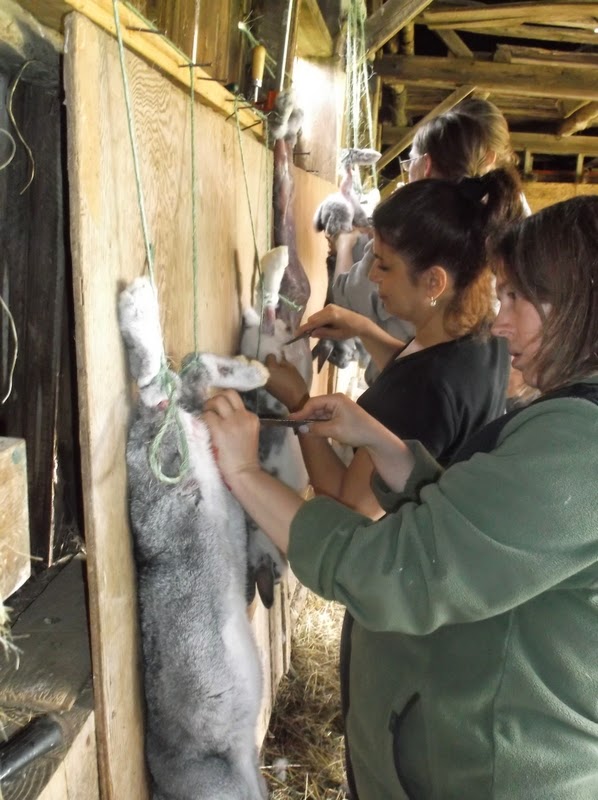
Next, we went to Local Farm to harvest some rabbits we'd pre-purchased from Alden's Rabbitry. After a pot-luck lunch featuring Rabbit Pot-Pie, Margaret demonstrated and we learned to break the rabbits' necks using a broom handle to hold their heads in place. We were fortunate to find the killing went quickly and relatively humanely. We were also very thankful not to have set off the ear-piercing, heart-wrenching, nervous system vocal spasm that sometimes happens.
  Under the guidance of Margaret and Kate, we skinned and gutted the carcasses.
Margaret told us about her experience tanning rabbit hides and we left ours with her with possible plans to return to help her with that. We washed, cooled and bagged our fresh lapin and went home with plans of how we'd prepare it after thoroughly chilling it for 4 to 12 hours.
Visit Honest-Food.net fried-rabbit-recipe/ for how to cut up a rabbit and batter fry it. YUM!

Thursday, March 19, 2015

Apronathon

Camp Eureka staff are making aprons to sell to make money for this summer's camperships. Please consider making a donation to help us bring more kids to camp!

Saturday, March 14, 2015

Best BEEginnings Yet!

Today's Old Style Life-Skills Series workshop BEEginning with Bees held at the Taghhannuck Grange Hall was BEEzy and inspiring!
 Todd Shearer showed us his top bar hive...
...with honeycomb the bees had built last summer 

...and filled with honey. 
 Jen Worden showed us her Langstroth hive...
 ...with a homemade candy box she uses for feeding the bees during winter.
Joe Benete demonstrated using a stethoscope attachment to listen for vibrations of living bees in the hive...
...and a special board he designed for wiring foundation wax into the frames.
We learned different techniques for installing a new package of bees,

...how to use a hive tool for cleaning and prying the frames,
 ...how to use a smoker, and many other tricks of the trade.
After a honey of a pot-luck lunch, we hand-dipped beeswax candles and made a batch of Alton's bee-candy for feeding the bees.

Wednesday, July 30, 2014

Wreath-Visiting Bailing Twine Wreaths

 Making wreaths out of reused bailing twine is both challenging and rewarding.
Although I don't have written directions... here are some hints:
*cut twine at the knots as you feed out hay - this makes it easy to pull individual pieces from a bundle and creates a nice starting place for the braid
*count out three equal bundles of twine and wrap one piece of the bundled twine around the bunch just below the knots
*put all three together and similarly, wrap them tightly together with one piece, & tie so the end dangles inside the bundle.
*bend a wire coat hanger in a circle with pliers and the hook down to make a ring for hanging up the finished wreath
*lay the bundled knots on the wire coat hanger circle, directly across from the hanging ring.
*braid around the circle, incorporating the hanging ring when you come to it.
*when you get all the way around, wrap one of the end pieces of twine around the bunch of knots and the other end pieces so they hang together.
*I like to trim the hanging end pieces so they are the same length.
*check the photos in these blog posts for more ideas: 
* you just have to fiddle with it until it looks right to you.

Saturday, March 22, 2014

FreeBEE Honeybee BEE

25 beekeeping enthusiasts BUZZED over to the Taghhannuck Grange Hall to Motherhouse's first FREE-BEE honeybee BEE. BEEginner, experienced, and wanna-BEE beekeepers shared their stuff!
Todd Shearer brought in and showed us a top bar hive designed by the Barefoot Beekeeper, He chose this style BEEcause he could build it himself and the bees are usually calmer to work. His family is dedicated to working with nature to create a permiculture, bio- and educationally diverse yard... I call it "Shearer Heaven."
Wyatt Whiteman showed us his elegantly simple homemade solar wax cleaning system. Using all recycled materials; wooden box with scrap lumber props, black plastic paint tray, food tray, hardware cloth, and window frame painted with leftover paint,
Wyatt lays wax scraps on the hardware cloth, closes the window; the sun melts the wax; it drips onto the paint tray, runs down into the lower edge, thru the small center opening, into the smaller food tray; leaving debris behind.

To make candles, he pours the wax from the food tray directly into a mold. He threads the mold with a long length of wicking, and winds it around the mold to keep it closed. When removing the candle, he pulls just enough wick through the mold to set it up for the next candle.
Joe Benete showed us the "tools of the the trade." Then a panel of  backyard beekeepers waxed enthusiastically about their experiences.

Fair-trade, organic coffee and chai tea made with local B&B honey and Thorncrest Dairy milk was generously provided by Coffee, Tea, Etc.
To deter bears, panelists recommended Sonpal's Power Fence (860 491-2290) and/or keeping goats, and a cow, and many active children in the yard.
After a honey of a potluck lunch, local herbalist Alicia North of North Star Botanicals , gave a BEEutiful presentation of foraging honeybees and BEEnificial plants.

Visit the Motherhouse website for a fellow beekeeper's poem about beekeeping and life.

Saturday, March 8, 2014

SPINspiring WoolWorks Workshop

We had our arms full as nearly 40 people RAMbled by the Taghhannuck Grange Hall for the EWEnique Motherhouse Old Style Life-Skills Series workshop; WoolsWorth.
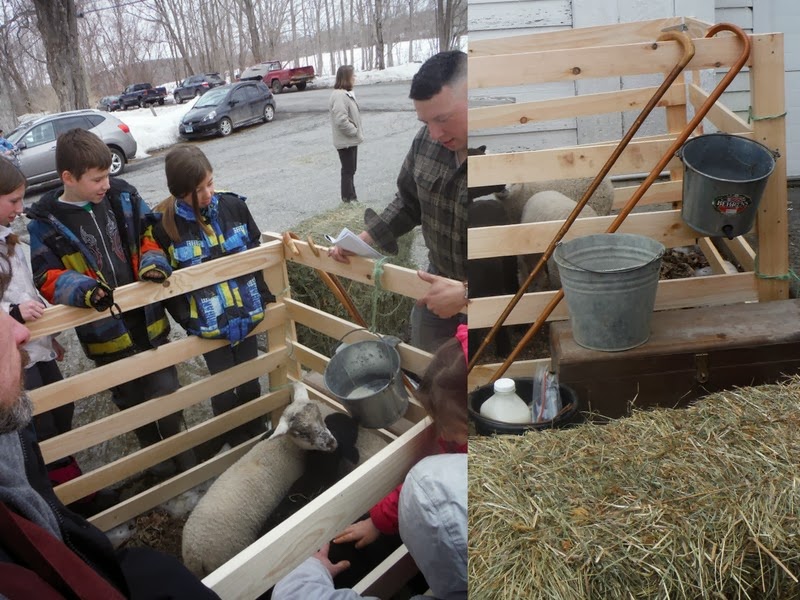
Joe Benete brought 4 young lambs for us to meet. He feeds the smallest with a nipple pail.
Dody and her pet sheep, Rose, taught crocheting.

Young Darwin taught finger weaving...

...so well that we all could do it.

Tal of New Twist showed us how to use a drum carder to comb the wool fibers in one direction to make for easy spinning...

...and then how to use a wooden spindle to spin the fibers into yarn.

Vera let us take a spin at her wheel... and showed us some of her naturally dyed homespun yarn. With alum as her mordant, these three colors are from goldenrod blossoms, black walnut husks, and spruce cones.

Dr Hayden stopped by to visit his former patient.

With Rachel's guidance, some of us put a new spin on old CDs...
...and used them to make our own spindles.

...and Margaret provided the icing on the cake for our pot-luck lunch.
All in all, it was a WOOLy good shEWE!!!
To learn about raising your own sheep and goats, come to our OSLSS workshop Get Your Goat and Sheep on May 10.